| TL;DR: Whether you should edit your podcast yourself or hire a professional comes down to three things: your time, your skill level, and what stage your podcast is in. Here is how to decide and what podcast editing actually costs in 2026. |
Podcast editing is where most podcasters lose time, energy, and motivation.
It is also the part of the process with the most options. And the part that is most likely to be the real reason your publishing schedule is inconsistent.
The question is not just whether you can edit your own episodes. Technically, most people can. The question is whether you should, for how long, and at what cost to the rest of your business.
I started editing my own podcast episodes. I learned the process, figured out what good audio actually sounds like, and built the skills that eventually allowed me to offer editing as a service to clients. That foundation shaped how I teach podcasting today.
Here is what I learned from both sides of the microphone.
What Podcast Editing Actually Involves
Most people underestimate what editing a podcast episode actually requires.
It is not just pressing delete on the moments where you said um. A full edit of a podcast episode includes:
- Removing long pauses, filler words, false starts, and mistakes
- Leveling out volume so every voice is heard clearly
- Reducing or removing background noise, echo, and room sound
- Adding your intro, outro, and any music or sound effects
- Exporting the final file in the correct format and specs for your hosting platform
The industry average for podcast editing is 3 to 4 hours of editing time per 1 hour of recorded audio. That number goes up for interview episodes with multiple voices, remote guests, and inconsistent audio quality. It goes down as you get faster with your software and as the quality of your raw recordings improves.
What that means practically: a 30-minute solo episode is typically 1.5 to 2.5 hours of editing work. A 45-minute interview with a remote guest can easily take 3 to 4 hours.
Multiply that by your publishing frequency and you have your real editing time commitment per month. That number is what should drive your decision on whether to edit yourself or hire out.
Need editing support for your show? Explore Podcast Editing and Production Services here
Should You Edit Your Own Podcast?
Yes, at first. And then it depends.
I edited my own episodes for years before I started offering editing as a service to clients. That time was not wasted. Learning your own show from the inside, hearing exactly where you ramble, where you rush, and what your natural rhythm sounds like, makes you a better host and a better content planner.
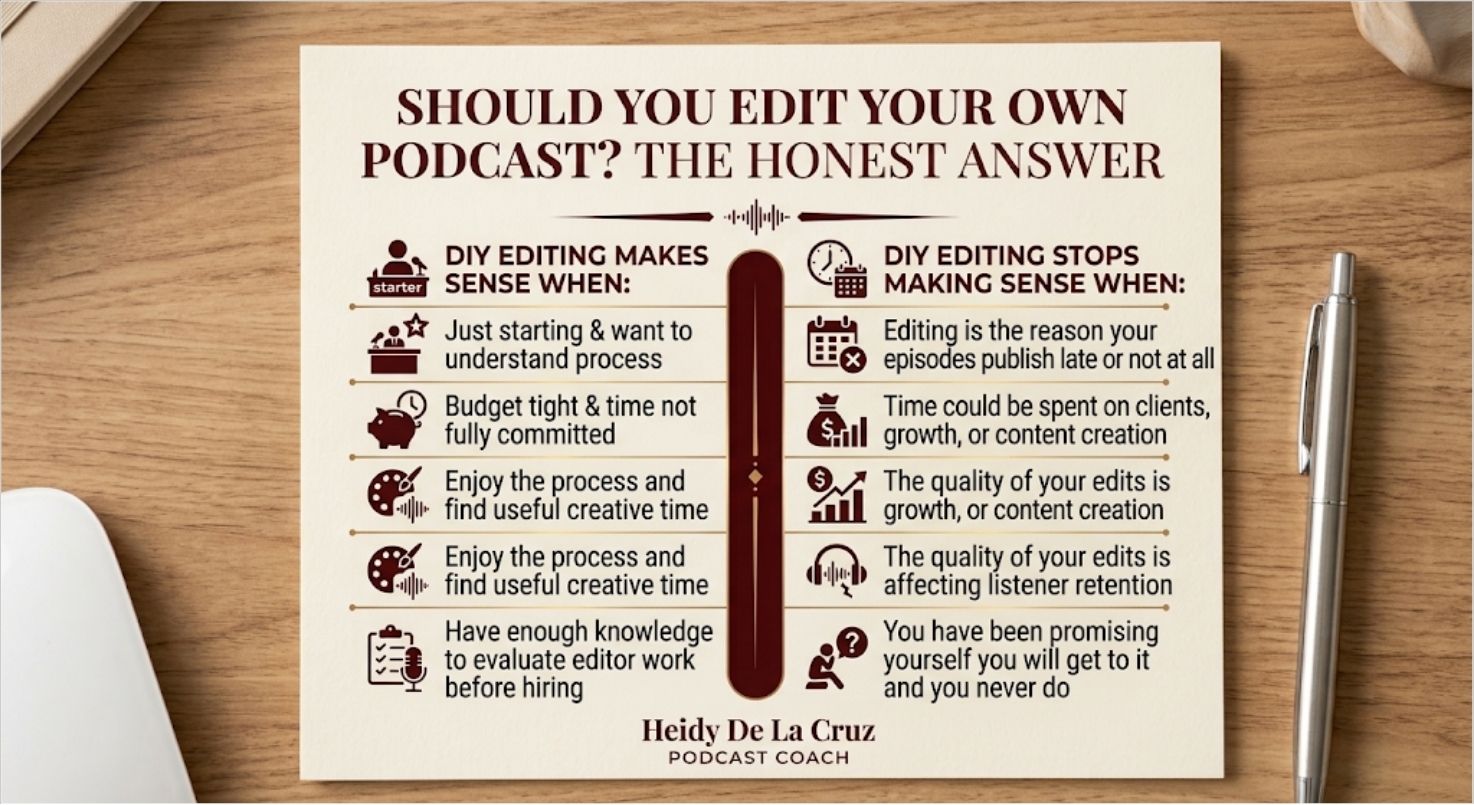
DIY editing makes sense when:
- You are just starting and want to understand the process before outsourcing it
- Your budget is tight and your time is not yet fully committed elsewhere
- You genuinely enjoy the editing process and find it useful creative time
- You want to have enough knowledge to evaluate an editor’s work before hiring one
DIY editing stops making sense when:
- Editing is the reason your episodes publish late or not at all
- The time you spend editing could be spent on client work, content creation, or growing the show
- The quality of your edits is affecting listener retention
- You have been promising yourself you will get to it and you never do
The most honest version of this question is not “can I edit my own podcast” but “is editing my own podcast the best use of the hours I am spending on it.”
How Much Does It Cost to Hire a Podcast Editor?
Podcast editing costs vary widely depending on the scope of work, the editor’s experience, and whether you are paying per episode or on a retainer.
Here is a realistic breakdown of what the market looks like in 2026:
| Service Type | Typical Price Range | What Is Usually Included |
| Per episode (basic) | $30 — $80 | Audio cleanup, cuts, leveling, export |
| Per episode (full service) | $80 — $150 | Edit + intro/outro + show notes formatting |
| Monthly retainer (audio only) | $200 — $500/mo | Weekly episodes, consistent turnaround |
| Full service package | $300 — $1,500/mo | Edit + show notes + publishing + promotion clips |
| Coaching and editing bundle | Varies by coach | Strategy + production support combined |
Now compare that to the cost of doing it yourself.
If you are working with a smaller budget, and editing takes you 3 hours per episode, every episode costs you $225 in time. At that rate, outsourcing editing for $60 per episode is not an expense. It is a $165 savings per episode that you can put toward client work, content strategy, or growing the show.
The math changes based on your rate and your editing speed. But for most entrepreneurs, the time cost of self-editing exceeds the money cost of hiring out faster than they expect.
How Long Does It Take to Edit a 30-Minute Podcast Episode?
For a 30-minute finished episode, plan for 1.5 to 3 hours of editing time depending on:
- The quality of your original recording — a clean, quiet recording cuts editing time significantly
- How much cleanup is needed — a polished speaker with minimal filler words takes less work than a rambling conversation
- Whether music, a custom intro, or an outro are being added
- Your familiarity with your editing software
For interview episodes with remote guests, those numbers go up. You are dealing with two or more audio tracks, different microphone setups, potential internet connection drops, and background noise from multiple environments. A 30-minute interview episode can take 3 to 4 hours to edit well.
The most reliable way to reduce your editing time is to improve your recording setup first. A better microphone, a quieter recording space, and a simple windscreen can cut your editing time in half before you touch the software.
Related: The Podcast Launch Checklist: 6 Things You Need Before You Record Episode 1
Best Practices for Podcast Editing Workflow Optimization
Whether you edit yourself or outsource, a streamlined workflow reduces time, reduces errors, and makes the whole process more sustainable.
Record clean audio at the source.
The easiest editing is the editing you do not have to do. Record in a quiet room, use a decent microphone, and speak close to it. These three habits reduce post-production significantly. I use Auphonic to clean up audio automatically before I even open my editing software. It handles noise reduction, leveling, and loudness normalization in minutes.
Use templates for your structure.
Your intro and outro should be the same every episode. Build a template in your editing software with your music and branded elements already in place. Every new episode starts from that template. No rebuilding from scratch every time.
Batch when possible.
If you batch record two or three episodes in one session, you can batch edit them too. Staying in the editing headspace for a longer block is more efficient than switching in and out of it week to week.
Tools worth knowing.
Descript is excellent for beginners because it lets you edit audio by editing the text transcript. Audacity is free and powerful for basic editing. Adobe Audition is the professional standard for more complex work. Auphonic is the fastest option for automated cleanup before your main edit.
Related: My Process for Planning Solo Podcast Episodes — how a strong content planning process reduces editing work downstream.
Can Professional Podcast Editing Improve Listener Engagement?
Yes. And the data is consistent on this.
According to Edison Research’s Podcast Landscape report, 25% of listeners who stopped following a show cited losing interest in the content. But audio problems, including inconsistent volume levels, background noise, and poor recording quality, are consistently listed among the top reasons listeners abandon shows before they ever build loyalty to the content.
Research on podcast listening behavior from Spotify and Edison Research consistently identifies audio quality as a top-three reason listeners stop following a show, alongside content relevance and inconsistent publishing schedules.
Listeners may not consciously notice when audio is excellent. But they absolutely notice when it is not.
What bad audio actually costs you:
- Listeners stop episodes early rather than working through poor sound quality
- First-time listeners do not return if the audio creates friction on their first impression
- Inconsistent volume between speakers in interviews is one of the most commonly cited audio complaints from podcast listeners
- Background noise and echo reduce the perception of credibility and professionalism regardless of the quality of the content
What professional editing adds beyond clean sound:
- A consistent listening experience that builds familiarity and trust over time
- Tighter pacing that respects the listener’s time
- A polished first impression that signals the host takes the show seriously
- Branded intro and outro that make the show feel like a show, not a recording
The shows that survive past episode 30 have almost universally solved the audio problem, one way or another. Whether that means improving their own skills or bringing in a professional editor, the audio is not something the audience has to work around.
How to Choose a Professional Podcast Editing Service
Not every podcast editor is the right fit for your show. Here is what to look for:
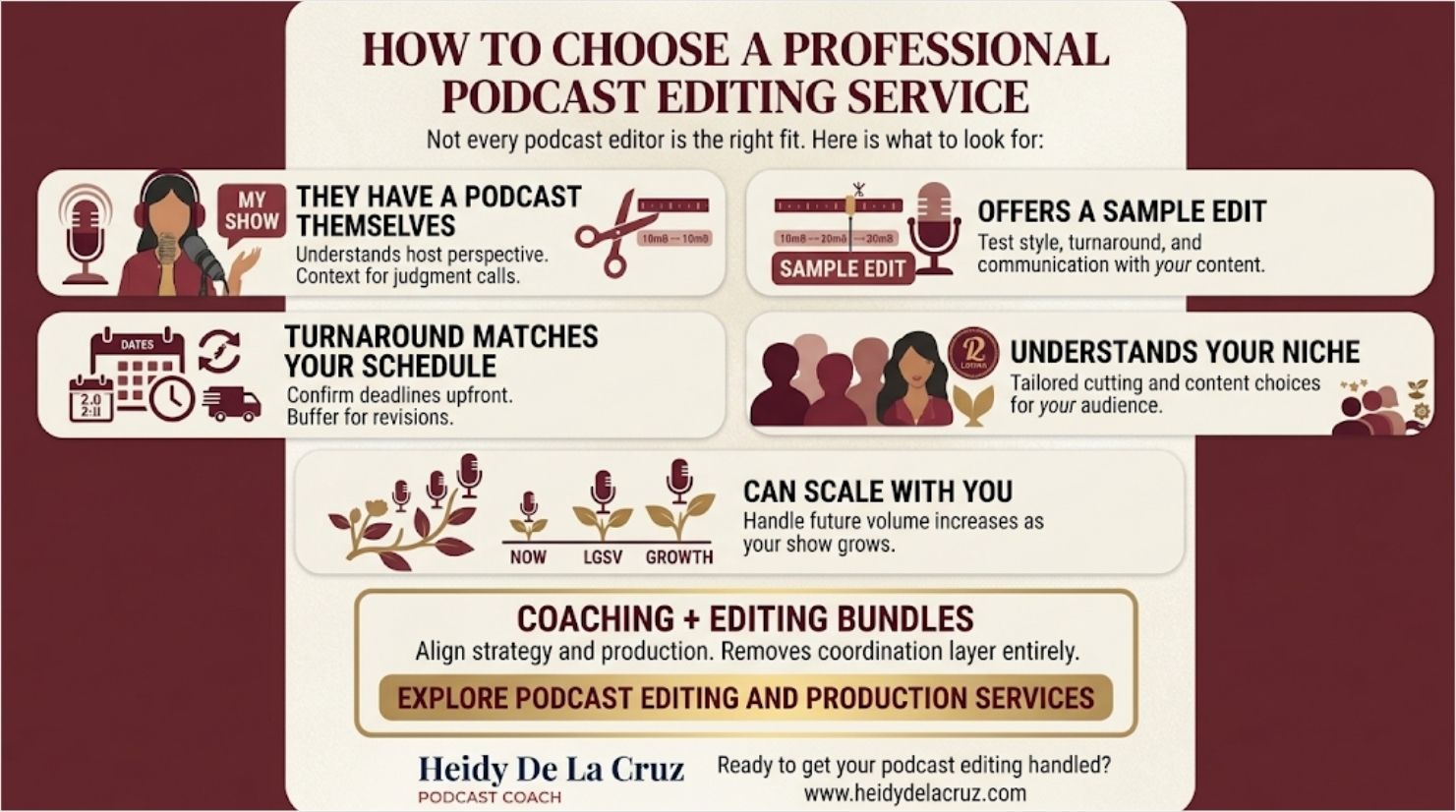
They have a podcast themselves.
An editor who hosts their own show understands the host’s perspective. They know what good audio feels like to produce and what it feels like to listen to. That context matters when they are making judgment calls about your content.
They offer a sample edit.
Before committing to a retainer or a package, ask for a sample edit of one of your actual episodes. This is the only way to know whether their style, their turnaround time, and their communication work for you.
Their turnaround time works with your schedule.
If you publish on Tuesdays and your editor delivers on Mondays, that is a problem. Confirm turnaround time upfront and make sure it builds in enough buffer for revisions.
They understand your niche and your audience.
An editor who works primarily with true crime shows will approach your Latina entrepreneur podcast differently than someone who understands your space. The tightening choices they make, what to cut, what to keep, depend on knowing what your audience values.
They can scale with you.
If you are publishing biweekly now but plan to go weekly in six months, make sure your editor can handle that volume. Getting a new editor every time your show grows is disruptive.
For podcast coaching and editing service bundles, working with a coach who also offers editing removes the coordination layer entirely. Your strategy and your production are aligned because the same person understands both.
Ready to get your podcast editing handled? Explore Podcast Editing and Production Services here
Best Podcast Editing Services for Interview-Style Shows
Interview podcasts have specific editing needs that solo shows do not, and not every editor handles them well.
The core challenge is multiple audio sources. Your voice and your guest’s voice are recorded in different environments, with different microphones, different levels, and different background noise profiles. A good interview editor brings all of those tracks into a cohesive, natural-sounding conversation.
What to specifically look for in an editor for interview-format shows:
- Experience editing multi-track remote recordings, not just single-voice solo episodes
- Ability to match volume levels between host and guest without making it sound artificial
- Skill at handling crosstalk and overlapping speech without losing context
- Patience with guest audio that may be lower quality than the host’s
- Understanding of pacing in conversations, knowing when silence adds to the episode and when it needs to be trimmed
The best way to evaluate an editor for interview work is to give them an actual interview episode for the sample edit. A solo episode sample will not tell you how they handle the complexity of a guest conversation.
Related: 4 Podcast Coaching Services to Help You Launch, Grow, and See Results
Where to Find a Reliable Podcast Editor
Here are the real options, with honest notes on each.
Referrals from other podcasters.
This is the most reliable path. Ask podcasters in your niche who edits their show and whether they would recommend them. A referral from someone whose audio you have already heard removes most of the guesswork.
Podcast communities and Facebook groups.
Groups specifically for podcasters often have editors actively looking for clients. You can post what you need and get direct responses. The quality varies, so still ask for a sample edit before committing.
Fiverr and Upwork.
Both platforms have podcast editors at a range of price points. The lower end can be hit or miss. Look for editors with strong reviews specifically from podcast clients, not just general audio work. Always request a sample before hiring.
Dedicated podcast production agencies.
Agencies offer more consistency and often more comprehensive services, but at a higher price point. If you are looking for a full production partner rather than just an editor, an agency may be worth the investment.
Coaches who also offer editing.
This is the option most people do not consider until they need it. A coach who also edits brings strategic context to the production work. They are not just cleaning your audio. They understand what you are trying to build and can flag content issues alongside technical ones.
Red flags to watch for when hiring:
- No sample edit offered or available
- Vague turnaround times with no guarantee
- No podcast experience on their portfolio, only music or general audio work
- Pricing that seems too low to be sustainable long-term
- No clear communication process for revisions or feedback
Want to talk through your editing options and what makes sense for your show right now? Book a 1:1 Strategy Call here
FAQ: Podcast Editing
What is the difference between a podcast editor and a podcast producer?
A podcast editor handles the audio. They take your raw recording and turn it into a clean, polished, publishable episode. Their job ends when the audio file is ready. A podcast producer handles the backend of running the show: guest coordination, scheduling, show notes, publishing, and promotion. Many podcasters confuse the two because some editors offer both services, but they are distinct roles. Figure out where your actual bottleneck is before hiring for either.
Can I start a podcast without editing software?
Technically yes. Some hosting platforms have basic built-in editing tools. Some podcasters publish episodes with minimal editing, particularly for conversational formats where a natural feel is part of the brand. But for most shows, some level of editing improves the listener experience significantly. At minimum, trimming the start and end and leveling the volume are worth doing before every episode goes out.
Is there a podcast editing course for beginners?
Yes. Descript’s own tutorials are a strong starting point because the software is beginner-friendly. Udemy and Skillshare both have podcast editing courses covering Audacity and Adobe Audition. The V.O.I.C.E. Method Podcast Launch Course also covers the editing workflow as part of the full launch process, so you understand what editing should involve before you decide whether to DIY or hire out.
About the Author & Podcast Coach
Heidy De La Cruz is a podcast coach, host, and creator of the V.O.I.C.E. Method. Her podcast The American Dream in the Eyes of Immigrants is a 2-time award winner recognized by the Women in Podcasting Awards and Women Who Podcast. It ranks in the top 5% of podcasts globally, #1 on GoodPods for Immigration, and holds #1 keyword rankings on both Spotify and Apple Podcasts.
After launching her first podcast in 2022, she saw how many women had powerful stories, business ideas, and something worth saying but felt completely stuck by the tech, the moving parts, and the lack of a clear starting point.
Now she helps aspiring podcasters go from idea to live show with clear, hands-on support that makes launching feel doable instead of overwhelming.
Explore her services: 1:1 Podcast Launch Strategy, The V.O.I.C.E. Method Podcast Launch Course, and Podcast Editing and Production Services.
Key Takeaways
- The average podcast episode takes 3 to 4 hours to edit per 1 hour of recorded audio.
- DIY editing makes sense at the start. It stops making sense when it is why you are publishing late.
- Outsourcing editing for $60 an episode is a savings if your hourly rate is $75 and editing takes 3 hours.
- Audio quality is a top-three reason listeners stop following a show.
- The best day to hire an editor is before inconsistency costs you your audience.
- Always ask for a sample edit before committing to any editor.
- Interview shows need editors with specific multi-track experience, not just general audio work.
With Love, Heidy
Related Resources
- The Podcast Launch Checklist: 6 Things You Need Before You Record Episode 1 — Set your recording up right before editing ever begins.
- My Process for Planning Solo Podcast Episodes — Strong content planning reduces editing time downstream.
- How Often Should You Release a Podcast Episode? — Your editing capacity directly affects your publishing frequency.
- 4 Podcast Coaching Services to Help You Launch, Grow, and See Results — What coaching and production support together can look like.